
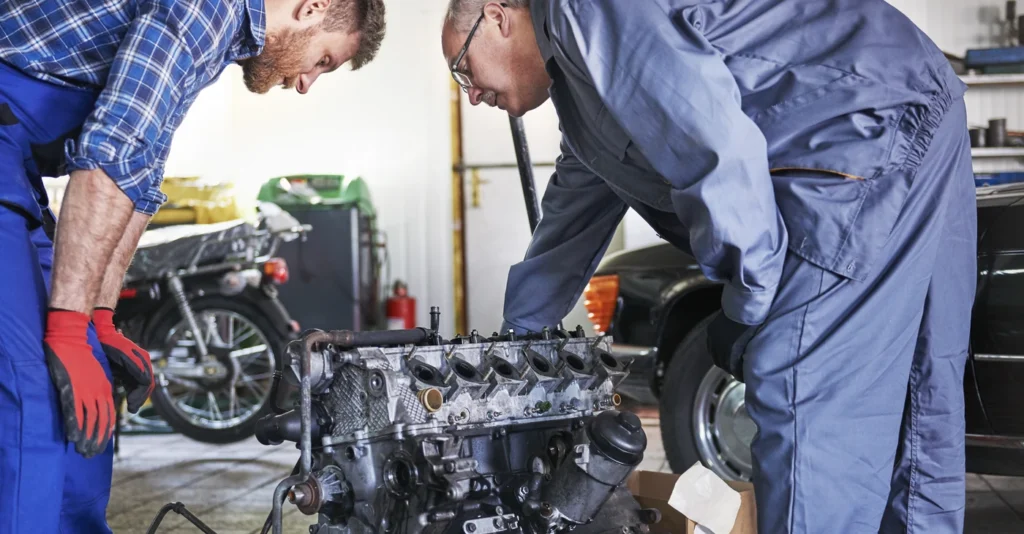
A cracked engine block is every car owner’s nightmare, but the good news is that it doesn’t always mean your engine is destined for the scrapyard. With the right approach, the right tools, and a clear understanding of what caused the damage, even a severely cracked block can often be saved. In this blog, we’ll break down the real-world repair methods from quick temporary fixes to professional, long-term solutions, so you’ll know exactly what’s possible, how each option works, and when it’s smarter to repair instead of replace. Let’s dive in and bring that engine back to life!
Looking for reliable engine repair in Houston? Don’t let a cracked engine block slow you down. Visit a trusted auto repair Houston shop for professional engine replacement and service you can trust.
If you’re searching for ‘auto repair near me,’ we’re ready to help — schedule your service today.
Tools for Repairing a Cracked Engine Block
- Socket and ratchet set
- Wrenches (metric and SAE)
- Screwdrivers
- Pliers
- Torque wrench
- Degreaser or brake cleaner
- Rags or shop towels
Signs of a cracked engine block
- Overheating
- Coolant Loss
- White Exhaust Smoke
- Milky Oil
- Poor Engine Performance
- Visible External Cracks
- Coolant–Oil Cross-Contamination
- Excessive Steam
- Low Compression
- Sweet Smell (Coolant Burning)
What Causes a Cracked Engine Block?
A cracked engine block doesn’t happen out of nowhere. It’s usually the result of extreme heat, pressure, or cooling system problems that push the engine beyond its limits. Below are the most common causes that lead to block failure, and after that, we have discussed each of its temporary and permanent repair guides.
1. Overheating
When the engine gets too hot, the metal expands beyond safe limits. This creates extreme stress that can split the block, especially around thin or weak areas.
Repair Guide:
Inspect / diagnose
- Check for white steam, rapid coolant loss, or boil-over signs.
- Inspect for warped cylinder head or head gasket failure.
- Look for visible crack lines on the block exterior.
- Pressure-test the cooling system and use a borescope to inspect cylinder walls if available.
Temporary (stopgap)
- Stop driving immediately to avoid worsening damage.
- Let the engine cool slowly; do not pour cold water on a hot engine.
- Top up coolant with the correct mixture; consider a commercial stop-leak per the product instructions for small external leaks.
- Monitor temperatures and avoid heavy loads or towing.
Permanent (step-by-step)
- Drain coolant and remove cylinder head(s) and ancillaries to access the crack.
- Clean and dry the cracked area (remove oil, rust, paint).
- Decide repair method:
- Cast iron: send to machine shop for metal-stitching (drill, insert locking pins, fill and finish) or preheated compatible welding if suitable.
- Aluminium: TIG/MIG welding with correct filler (usually requires machine-shop expertise).
- Cast iron: send to machine shop for metal-stitching (drill, insert locking pins, fill and finish) or preheated compatible welding if suitable.
- After repair, machine/deck/blend the repaired surface as needed.
- Pressure-test the repaired area for leaks.
- Replace head gasket, torque head bolts to spec, reassemble, refill coolant, and run thermal cycles while monitoring temps.
2. Freezing Coolant
If the coolant doesn’t have enough antifreeze, it can freeze in cold temperatures. Frozen coolant expands, putting enormous pressure on the block and causing it to crack from the inside.
Repair Guide:
Inspect / diagnose
- Inspect near coolant passages and freeze plugs for cracks or pushed-out plugs.
- Check coolant mixture with a refractometer or hydrometer to confirm antifreeze percentage.
Temporary (stopgap)
- Immediately replace lost coolant with a proper antifreeze/water mix.
- For a small external hairline crack, apply a coolant-safe epoxy or commercial block sealant per instructions (short-term).
- Avoid driving in freezing conditions until repaired.
Permanent (step-by-step)
- Drain coolant, remove head(s) and ancillaries for access.
- Replace damaged freeze plug(s) and repair surrounding metal if required.
- Repair cracked passages by welding (if material permits) or metal-stitching; if internal/severe, replace the block.
- Refill with manufacturer-specified antifreeze mix and pressure-test the system.
3. Poor Cooling System Maintenance
Rust, scale buildup, clogged coolant passages, or low coolant levels create hot spots. These uneven temperatures weaken the block and increase the chance of cracking.
Repair Guide:
Inspect / diagnose
- Flush and inspect the radiator, hoses, thermostat, and water pump.
- Pressure-test the cooling system and use a borescope to find localized corrosion or hot-spots in the block.
Temporary (stopgap)
- Perform a chemical radiator/block flush to remove scale.
- Replace thermostat, hoses, and coolant; run and monitor temps.
- Apply temporary epoxy or an external patch for small leaks until a permanent fix is arranged.
Permanent (step-by-step)
- Replace failed cooling components (water pump, radiator) and correct flow restrictions.
- If corrosion caused thin walls or pinholes, have a machine shop inspect:
- Small localized holes — professional welding, sleeving, or epoxy with sleeving may work.
- Widespread corrosion — replace block or perform long-block swap.
- Small localized holes — professional welding, sleeving, or epoxy with sleeving may work.
- Refill, pressure-test, and perform thermal cycling.
4. Extreme Engine Stress
Towing heavy loads, hard acceleration, racing, or running high turbo/boost levels puts intense pressure on the engine block, which, over time, can lead to fatigue and cracking.
Repair Guide:
Inspect / diagnose
- Inspect around cylinder bores, main caps, and other high-stress zones for cracks.
- Check for internal damage (warped heads, broken rods, bearing failure).
Temporary (stopgap)
- Reduce load: lower boost, stop towing/heavy use, and avoid hard acceleration.
- If a small external crack is visible, a high-temp epoxy can be used as a very short-term measure; do not operate at high RPMs.
Permanent (step-by-step)
- Disassemble to inspect internal components (pistons, rods, bearings).
- Repair external cracks by welding (aluminium) or metal-stitching (cast iron) and machine as needed.
- Replace any damaged internals (rods, bearings, pistons).
- Rebuild with correct torque/clearances and revert or correct tuning to safe parameters.
- Pressure-test and perform break-in procedures.
5. Thermal Shock
Rapid temperature changes, like dumping cold water into an overheated engine, cause the metal to contract or expand too quickly, resulting in sudden cracks.
Repair Guide:
Inspect / diagnose
- Confirm owner history for rapid cooling events (e.g., pouring cold water on a hot block).
- Inspect for radial cracks near water jackets and thin sections.
Temporary (stopgap)
- Allow the engine to cool naturally; do not run the engine until cooled.
- Apply temporary external sealants for small leaks.
Permanent (step-by-step)
- Remove heads and ancillaries, thoroughly dry and clean the block.
- Repair cracks with welding (if appropriate) or metal-stitching, depending on the material.
- Conduct careful heat-soak and pressure tests before return to service.
6. Detonation (Engine Knock)
Severe knocking or pre-ignition creates violent pressure spikes inside the cylinders. These pressure surges can stress the block and cause internal cracking.
Repair Guide:
Inspect / diagnose
- Inspect pistons, crowns, head, and cylinder walls for damage from detonation.
- Check spark plugs, combustion chamber deposits, and knock sensor data if available.
Temporary (stopgap)
- Reduce ignition timing, lower boost, and/or richen mixture to stop knocking.
- Drive gently and avoid loads until the root cause is fixed.
- Use higher-octane fuel temporarily if appropriate.
Permanent (step-by-step)
- Diagnose and correct root causes (timing, fueling, EGR, knock sensor, turbo tune).
- If a block cracked internally or piston damage exists: remove engine, repair block (weld/metal-stitch), or replace block.
- Replace damaged pistons, rings, and possibly liners; rebuild and retune the engine correctly.
- Pressure-test and monitor operation.
7. Manufacturing Defects
Although rare, casting flaws or weak spots in the metal from the factory can cause cracks to form later during normal engine operation.
Repair Guide:
Inspect / diagnose
- Look for cracks or porosity in odd locations or known weak spots for that engine family.
- Check for recalls, TSBs, or service bulletins on the engine.
Temporary (stopgap)
- If under warranty, stop using the vehicle and contact the dealer; do not perform repairs that could void the warranty.
- Use temporary external sealing only to prevent immediate fluid loss; avoid heavy loading.
Permanent (step-by-step)
- If under warranty: pursue replacement through the dealer/manufacturer.
- If out of warranty: repair options depend on defect location—professional welding/metal-stitching may be possible; otherwise replace block or swap long-block.
- When replacing, select a remanufactured/upgraded block and inspect for the same casting issues.
Time for an Engine Replacement? Eric’s Car Care Can Help!
A cracked engine block can feel overwhelming, but you don’t have to face it alone. When repair isn’t the safest or most cost-effective option, Eric’s Car Care specializes in professional engine replacement that restores your vehicle’s performance, reliability, and peace of mind.
Our skilled technicians handle the entire process from diagnosing the issue to installing a high-quality replacement engine so you get a smooth, dependable solution without the guesswork.
If your engine block is cracked, let Eric’s Car Care replace it with confidence, precision, and exceptional service. Get back on the road the right way starting today!